
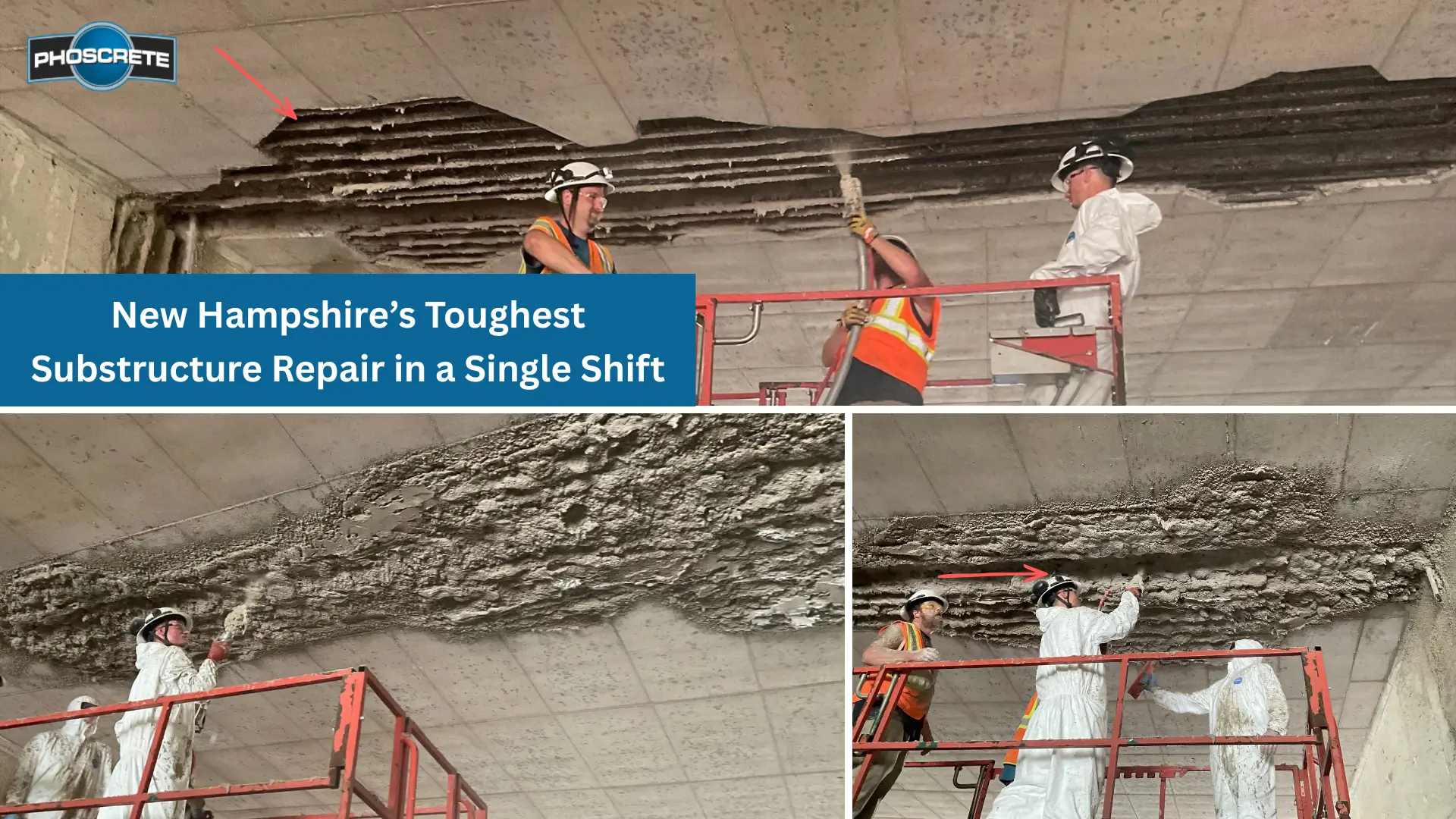
New Hampshire’s Toughest Substructure Repair in a Single Shift
156 kits. Vertical and overhead patches. One mobilization. Here’s what happened.
On June 24, 2025, the Phoscrete team completed what is now our largest single-day onsite spray application to date: 156 kits of Phoscrete F3-VO applied on the substructure of a bridge beneath the Spaulding Turnpike in New Hampshire, covering both vertical and overhead concrete repair in a single mobilization.
This is the project in detail.
The Site
The bridge at Spur Road and Bellamy Lane runs underneath the Spaulding Turnpike near Portsmouth, New Hampshire. It’s a low-clearance structure with limited staging space—and years of chloride infiltration had done their damage. Active rebar corrosion, concrete spalling, and delamination were visible on both the vertical walls of the substructure and the overhead ceiling.
For this phase, NHDOT needed to address vertical patches ranging from 4 to 6 inches in depth and overhead patches between 8 and 11 inches. The scale and geometry made hand-packing impractical. Forming and pouring wasn’t feasible. Phoscrete F3-VO and the ShotPump were selected for the repair.
The Crew
Six people on site: three mixers, one sprayer, two finishers. Each mixer is running an 8-gallon bucket and a Phoscrete paddle. The sprayer is managing the ShotPump nozzle. The finishers are working immediately behind the spray with large plastic float trowels.
The team also included Phoscrete application engineer Jorge Giro, sales engineer Kyle Bartfay, NHDOT principal engineer Levi Byers, and industry colleagues.
The Application
7:30 AM – Arrival
The crew arrived, set up equipment, and staged materials. The ambient temperature is approximately 85°F in the shaded tunnel environment.
7:45 AM – Rebar Coat
Phoscrete Rebar Coat (RC) mixed and applied to 5–6 spots with active rebar corrosion. RC wrapped up by 8:12 AM.
8:15 AM – Run 1 (39 kits)
F3-VO mixing began immediately after RC. Three mixers working in rotation fed the ShotPump hopper in sequence. Run 1 targeted the vertical patches. The spray nozzle worked across repair zones in methodical passes; finishers troweled immediately behind.
8:41 AM – Troweling Begins
The first vertical run was troweled smooth. The crew transitioned to overhead positioning.
9:08 AM – Run 2 (26 kits)
Run 2 shifted focus to the first layer of overhead repair and some additional vertical touch-up. Material was applied upward at controlled pressure, holding against gravity without visible slump or rebound.
10:23 AM – Run 3 (91 kits)
The largest single run of the day. All 91 kits applied overhead, building sections from 8 to 12 inches of material depth. The ShotPump handled it in one run.
11:15 AM – Complete
Final troweling done. The shot pump was cleaned and staged for transport. Site cleared. Four hours of active application time.
What the Numbers Say
- 156 total kits – Phoscrete’s record for a single-day onsite spray application.
- Run 1: 39 kits – vertical patches
- Run 2: 26 kits – first overhead layer + vertical finish
- Run 3: 91 kits—all overhead, 8–12” build-up
Surface temperature during active curing reached about 180°F, consistent with the exothermic reaction of MPC mortar. No delamination, no cracking, and no premature set were observed across any of the three runs.
Why It Worked
F3-VO’s material behavior.
Magnesium phosphate cement mortar sets differently than Portland cement-based products. It doesn’t shrink on cure. It bonds chemically to the substrate. At the right application consistency, it behaves like a thick putty that holds vertical and overhead placement without slump—even at 11-inch depths. When hand-packing, a crew covers one spot at a time. The spray method allowed much wider application coverage in continuous passes, which is what made the three-run schedule possible at this volume.
The ShotPump’s throughput.
The machine’s continuous-feed design lets a three-mixer crew maintain a consistent spray pace without stopping to hand-pack or reposition frequently. At this volume and complexity, hand-packing would have required more crew, more time, and likely a second mobilization.
MPC’s cold-joint advantage.
A cold joint forms when you apply concrete on top of already-cured concrete and the two layers don’t bond strongly—they stay as separate planes rather than a single structural unit. With Phoscrete, there are no cold joints. F3-VO bonds directly to the substrate and to itself across pour sequences. Run 2 bonded to Run 1. Run 3 bonded to both. The result is a monolithic structural repair, not a stack of independent layers.
What’s Next
NHDOT now has a completed baseline for how F3-VO behaves in bridge substructure environments with vertical and overhead exposure. The 156-kit, three-run, single-day record represents a scalable model for similar structures where geometry restricts conventional repair methods.
Are you evaluating concrete repair for vertical or overhead applications? Call us at 561-420-0595 now and we’d be glad to walk through your project specifics.
You can also use the live chat or submit the contact form on our website.