
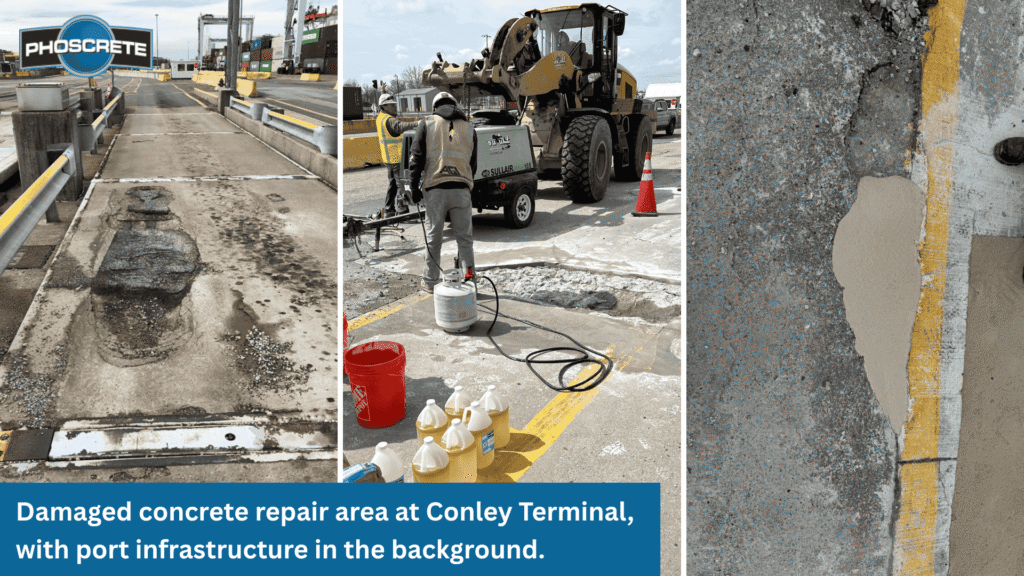
Fast Concrete Repair at an Active Port Environment
Key Installation Facts: Three patches were installed at Conley Terminal using Phoscrete Formula 1-HC. Patch sizes: 30 x 70 x 3; 24 x 45 x 2; 47 x 90 x 2. Material used: 21 bags total across three patches. Average patch completion: about 15 minutes per patch. Traffic-ready times documented: 11:00 AM, 11:55 AM, and…
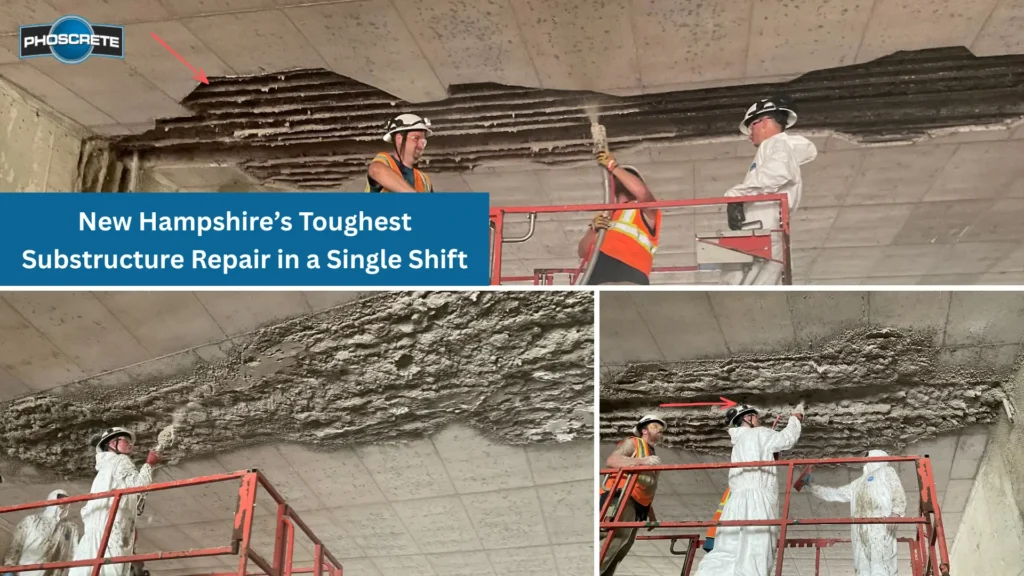
New Hampshire’s Toughest Substructure Repair in a Single Shift
156 kits. Vertical and overhead patches. One mobilization. Here’s what happened. On June 24, 2025, the Phoscrete team completed what is now our largest single-day onsite spray application to date: 156 kits of Phoscrete F3-VO applied on the substructure of a bridge beneath the Spaulding Turnpike in New Hampshire, covering both vertical and overhead…
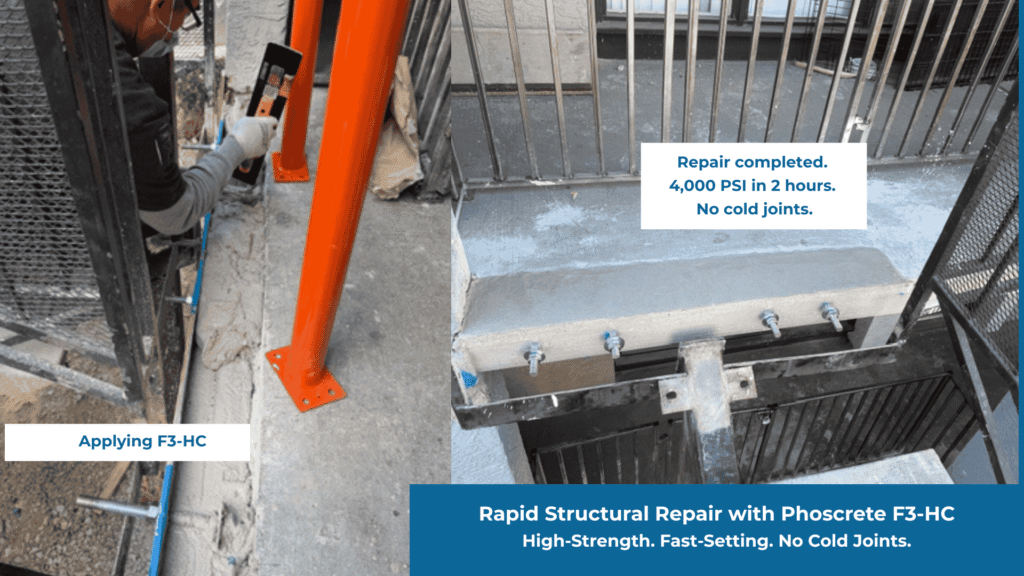
Rapid Structural Repair with Phoscrete F3‑HC
High‑Strength, No Cold Joints, Fast‑Setting Concrete Repair – Proven on the Job Site. Project Overview Customer: Restoration 2 LLC Location: Las Vegas, NV Product Used: Phoscrete F3‑HC Application: Form‑and‑pour cantilever repair with doweled anchors Timeline: Delivered Thursday → Poured Friday → Forms Removed Saturday The Challenge When contractors need fast-setting concrete repair that…

The Great Irony of Rebar Rusting in Concrete
Concrete is alkaline. Fresh Portland cement creates a high-pH environment – typically above 12.5 – that forms a passive oxide layer on embedded steel rebar, slowing corrosion under normal conditions. That protection works until something disrupts the chemistry. Two mechanisms break it down most commonly in infrastructure: carbonation and chloride intrusion. Understanding which one is…

The Crazy Strong Bond of Phoscrete MPC Concrete
Most structural concrete repairs fail at the bond line. The repair material itself holds, but the interface between new and existing concrete does not. That is the failure mode magnesium phosphate cement (MPC) is specifically designed to address. What Makes MPC Different from Ordinary Portland Cement Ordinary Portland cement (OPC) repairs a bond mechanically…

Phoscrete in Cold Weather: A Quick Guide
Cold Weather Concrete Repair with Phoscrete: A Practical Temperature Guide Temperature is the variable that determines which Phoscrete formula you use and what field adjustments you make. This guide covers formula selection by temperature range, practical cold weather handling steps, and how to manage both F1 and F3 when conditions run hot. Which…

Grateful for Your Trust: How Phoscrete Delivers More Than Just Concrete Repairs
What Backs the Trust Contractors Place in Phoscrete Contractors and engineers do not choose a concrete repair product on goodwill. They choose it because it performs when conditions are difficult, holds up after the crew leaves, and does not send them back to the same repair six months later. Here is what supports that confidence…

The Importance of Expansion and Control Joints in Infrastructure Preservation
Expansion joint header repairs are one of the more demanding concrete repair applications on bridge and parking structure programs. The header material bonds directly to a Portland cement concrete deck, bears constant vehicular impact and abrasion loads, and must accommodate the structure’s thermal movement without delaminating. Get the material wrong and you cycle back –…

Time is Money, and Phoscrete MPC Concrete Saves You Both
The cost of a concrete repair is not just the material. It is the crew hours, the lane closures, the equipment time, and the callbacks if the repair fails early. Rapid-set concrete repair with Phoscrete MPC changes the math on all four. Where the Time Goes in a Traditional Concrete Repair A standard OPC…

Innovation in Concrete Repair: Discover Phoscrete MPC Technology
Phoscrete MPC Concrete: Built for Durable Concrete Repair in Any Condition Most concrete repair materials come with a condition: don’t apply below 50°F, avoid direct sun, watch the humidity. Phoscrete’s Magnesium Phosphate Cement (MPC) concrete is engineered to work where those materials fall short. What Makes MPC Concrete Different Phoscrete MPC is a…